
Why Was My Pet Insurance Claim Denied, and How Can I Appeal?
A pet insurance claim may be denied because of a pre-existing condition, waiting period, excluded treatment, missing records, filing deadline or policy limit. A denial is not always the final step. Review the written decision, compare it with the policy and submit supporting evidence before the appeal deadline.

Can You Appeal a Denied Pet Insurance Claim?
Direct answer: Many pet insurers provide a process for requesting reconsideration of a denied or underpaid claim. The appeal normally needs to identify the claim, explain why the decision may be incorrect and include supporting documents.
Deadlines and procedures vary. Check the denial letter and policy immediately so that you do not lose the opportunity to appeal.
An appeal is strongest when it addresses the exact reason given by the insurer. Sending the same documents again without explaining the disputed point may not change the result.
Common Reasons Pet Insurance Claims Are Denied
| Denial Reason | What It Usually Means | What to Review |
|---|---|---|
| Pre-existing condition | The insurer believes signs, treatment or medical advice existed before coverage | Medical records, symptom dates and the policy definition |
| Waiting period | The condition or treatment began before the relevant waiting period ended | Policy start date, waiting-period dates and clinical notes |
| Excluded service | The treatment, fee or condition is not included under the selected plan | Coverage, exclusions, endorsements and optional benefits |
| Missing medical records | The insurer does not have enough information to establish eligibility | Records from every veterinarian involved in the condition |
| Incomplete invoice | The submitted bill does not clearly separate services and charges | Final itemized invoice and proof of payment |
| Benefit limit reached | The eligible expenses exceed an annual, per-condition or other limit | Explanation of benefits and remaining policy allowance |
| Deductible not met | The eligible amount did not exceed the remaining deductible | Deductible structure and previous eligible claims |
| Late submission | The claim was filed after the policy's required deadline | Invoice date, submission date and any permitted exceptions |
What to Do Immediately After a Denial
- Save the denial letter and explanation of benefits.
- Identify the exact policy clause used in the decision.
- Confirm the deadline for filing an appeal.
- Request the records reviewed by the insurer.
- Obtain complete records from every relevant clinic.
- Ask whether the appeal requires a specific form.
- Keep copies of every message and submitted document.
Do not rely only on a phone conversation. Request important explanations in writing so that you can address the insurer's stated reasoning.

Read the Denial and the Policy Together
The denial should identify why the claim was not paid or why the reimbursement was lower than expected.
Compare that explanation with:
- The coverage section
- The exclusions section
- The pre-existing-condition definition
- The waiting-period language
- The deductible and reimbursement terms
- The benefit-limit provisions
- The claim and appeal deadlines
The guide to reading a pet insurance policy can help you locate these sections.
What If the Claim Was Denied as Pre-Existing?
Ask the insurer to identify the medical record, symptom, diagnosis or treatment it relied on. Then compare that information with the current condition.
Confirm whether the earlier and current problems involve the same body part or a related bilateral condition.
Determine whether the previous notes describe the same signs or a medically different problem.
Compare the first documented symptom with the policy start date and waiting period.
Ask the veterinarian whether the prior condition is medically connected to the current diagnosis.
Review the detailed rules for pre-existing pet insurance conditions before preparing the appeal.
Can Your Veterinarian Help With the Appeal?
A veterinarian can clarify the medical timeline, diagnosis and relationship between earlier symptoms and the current condition.
Useful veterinary support may include:
- A corrected or clarified clinical note
- A letter explaining when the condition began
- An explanation of why two diagnoses are unrelated
- Complete laboratory and imaging results
- A specialist's assessment
The veterinarian cannot rewrite the policy or guarantee reimbursement, but accurate medical evidence can help the insurer reassess disputed facts.
What Should a Veterinary Letter Explain?
A useful letter should be specific and based on the medical record. It may explain:
- The date symptoms first appeared
- The date the current condition was diagnosed
- Whether earlier symptoms were related
- Whether the condition was acute or chronic
- Why the treatment was medically necessary
- Which records support the opinion
A short statement that the pet was healthy may be less useful than a detailed explanation tied to examination findings and dates.
What If the Claim Was Denied for Missing Information?
First determine whether the claim was formally denied or placed on hold pending documents. The next step may be as simple as completing the file.
| Missing Item | Where to Get It |
|---|---|
| Complete medical notes | The treating veterinarian and previous clinics |
| Itemized invoice | The veterinary clinic's billing department |
| Proof of payment | Clinic receipt, payment confirmation or account statement |
| Diagnostic report | Laboratory, radiology provider or specialist |
| Claim form | The insurer's portal, application or customer-service team |
| Medical history from another clinic | The former veterinarian, emergency hospital, shelter or rescue |
What If the Claim Was Paid but the Amount Looks Wrong?
A partial payment may result from the deductible, reimbursement percentage, ineligible fees or a benefit limit rather than a complete denial.
Compare the insurer's calculation with:
- The total veterinary invoice
- The amount classified as eligible
- The remaining deductible
- The reimbursement percentage
- Any excluded examination fees
- The remaining annual limit
The guide to pet insurance reimbursement explains how an eligible bill can become a smaller payment.
Example of a Partial Payment
| Total bill | $2,000 |
| Excluded charges | $200 |
| Eligible amount | $1,800 |
| Remaining deductible | $300 |
| Amount after deductible | $1,500 |
| Reimbursement at 80% | $1,200 |
This simplified example may not match every provider's calculation method.
Was the Claim Affected by a Limit or Deductible?
The policyholder may need to satisfy the remaining annual deductible before reimbursement begins.
A separate deductible may apply when the claim involves a new medical condition.
Claims may stop receiving reimbursement after eligible payments reach the yearly maximum.
The contract may place a separate ceiling on treatment for one diagnosis or category.
Review the differences between pet insurance deductibles and annual benefit limits before disputing the calculation.
How to Appeal a Denied Pet Insurance Claim
- Read the appeal instructions. Follow the form, address, portal and deadline specified by the insurer.
- Identify the claim. Include the policy number, pet's name, claim number and date of service.
- State the disputed decision. Explain whether you disagree with a pre-existing classification, exclusion, timeline or payment calculation.
- Refer to the policy. Identify the wording that supports your interpretation.
- Present the medical timeline. List the important examination, symptom, diagnosis and treatment dates.
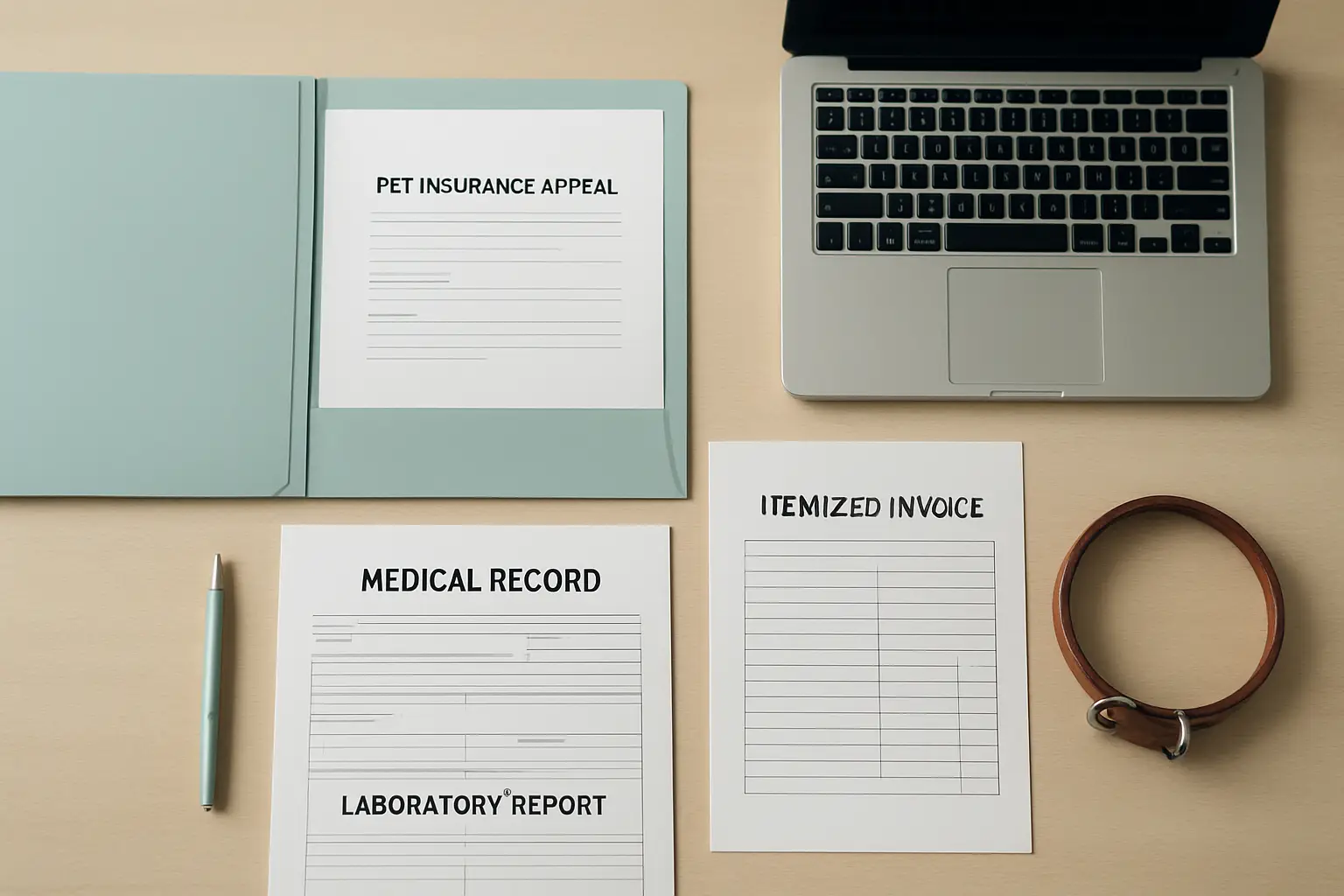
- Attach supporting evidence. Include records, invoices, test results and veterinary clarification.
- Request a specific outcome. Ask the insurer to reconsider the stated claim and provide a written response.
- Keep proof of submission. Save the confirmation, attachments and submission date.
Appeal deadlines vary. Do not assume you have a standard number of days. Use the deadline shown in the denial letter and policy.
Pet Insurance Appeal Letter Outline
Subject: Request for reconsideration of claim [claim number]
I am requesting a formal review of the claim decision dated [date] for [pet's name], policy number [policy number].
The decision states that the claim was denied or reduced because [quote or summarize the stated reason].
I believe the decision should be reconsidered because [briefly explain the disputed medical fact, timeline, policy provision or calculation].
The attached documents include [list the veterinary records, itemized invoice, diagnostic results, policy pages and veterinary clarification].
Please review this information and provide a written determination explaining how the policy applies to the claim.
Sincerely,
[Policyholder name]
[Contact information]
Replace every bracketed field with accurate information. Keep the letter factual and focused on the exact claim decision.
Documents to Include With the Appeal
- The denial letter or explanation of benefits
- The relevant policy pages
- Complete veterinary clinical notes
- The final itemized invoice
- Proof of payment
- Laboratory and imaging reports
- Specialist findings
- A veterinary clarification letter
- A dated medical timeline
- Previous insurer correspondence
Include only documents that support the disputed issue, but do not omit relevant records that could change the interpretation.
What Happens After You Submit the Appeal?
The insurer may:
- Uphold the original decision
- Request additional records
- Reclassify part of the claim
- Issue an additional reimbursement
- Reverse the denial
Keep paying attention to deadlines while the appeal is under review. Respond promptly when the insurer requests more information.
Ask for the final appeal decision in writing, including the policy wording and medical evidence used.
What If the Internal Appeal Is Unsuccessful?
Review the policy for any additional appeal or complaint process. You can also contact the insurance regulator in your state when you believe the insurer did not follow the policy or applicable requirements.
A regulator may review claim-handling practices and require the insurer to respond. It does not guarantee that the claim will be paid.
Keep the denial, appeal, final response, policy, records and proof of submission together before filing a complaint.
When Professional Advice May Help
Consider seeking appropriate professional guidance when:
- The disputed amount is substantial
- The policy wording is difficult to interpret
- The insurer alleges fraud or misrepresentation
- The appeal deadline has passed
- The medical timeline is complex
- You are considering legal action
This article is educational and does not provide legal advice.
Should You Cancel the Policy After a Denial?
Do not cancel only because one claim was denied without first reviewing the long-term effect.
Conditions that developed under the current policy may be classified as pre-existing by a new insurer. Starting a replacement policy can also introduce new waiting periods.
Read the risks of switching pet insurance providers before ending active coverage.
How to Reduce Avoidable Claim Problems
Review exclusions, limits, waiting periods and appeal procedures before enrollment.
Provide full clinical notes rather than only a vaccination sheet or short visit summary.
Make sure every examination, test, procedure and medication has a separate charge.
Submit claims and appeals within the period required by the policy.
A lapse or provider change may create new waiting periods and pre-existing-condition issues.
Written decisions are easier to compare with policy wording and medical evidence.
Use the Denial Reason to Build the Appeal
A strong appeal does not simply state that the decision feels unfair. It identifies the disputed policy or medical issue and provides evidence that directly addresses it.
Save complete records, follow the insurer's procedure and submit everything before the stated deadline.
Compare Pet Insurance PoliciesThe Bottom Line
Pet insurance claims may be denied because of pre-existing conditions, waiting periods, exclusions, limits, deductibles, filing deadlines or missing documentation.
Some denials correctly apply the policy. Others may result from incomplete records, disputed medical relationships or an incorrect calculation.
Read the written decision, gather supporting evidence and use the insurer's formal appeal process before the deadline.
Frequently Asked Questions
Why was my pet insurance claim denied?
Common reasons include pre-existing conditions, waiting periods, excluded treatment, missing records, benefit limits, deductibles and late submission.
Can I appeal a denied pet insurance claim?
Many insurers allow a formal appeal or reconsideration. Follow the instructions and deadline shown in the policy or denial letter.
How long do I have to appeal?
The deadline varies by insurer and policy. Check the denial notice immediately rather than assuming a standard appeal period.
Can my veterinarian help with an appeal?
A veterinarian can clarify the diagnosis, symptom timeline, medical necessity and relationship between earlier and current conditions.
Can a claim be denied for missing records?
A claim may be delayed, closed or denied when the insurer cannot obtain the records needed to establish eligibility.
Can I appeal an underpaid claim?
You may be able to dispute a reimbursement calculation when you believe the deductible, percentage, eligible amount or limit was applied incorrectly.
Should I cancel after a denied claim?
Review the consequences first. A new insurer may treat current conditions as pre-existing and impose new waiting periods.
Can I contact my state insurance department?
You can contact your state insurance regulator when you believe an insurer has not followed the policy or applicable claim-handling requirements.
Editorial note: This article provides general educational information and is not legal advice. Claim procedures, appeal rights and deadlines vary by insurer, policy and state. Review the complete contract and denial notice.